In nearly every breach report, email is the entry point but the way attackers use it has changed. Today’s attackers don’t just rely on dropping malware up front. More often, malware is the payload delivered after a convincing social engineering attempt succeeds. Instead, adversaries impersonate trusted senders, mimic real workflows, and exploit timing and context. One spoofed link, sent to the right inbox at the wrong time, can cause six‑figure damage before anyone catches on. These are no longer theoretical risks but advanced email threats that require smarter defences.
Blocking them without interrupting day‑to‑day operations requires intelligent security tools that adapt to risk, whilst delivering both insight and automation. Platforms like TrustLayer excel at securing business email while maintaining uninterrupted workflows. Our proactive approach to email threats and unique DirectProtectTM architecture ensures detection and prevention before damage is done.
Who is most at risk from email threats?
Attackers don’t target everyone equally. In regulated sectors like healthcare, finance, and legal services, email remains the dominant vector for compromise because it’s a gateway to sensitive data. These sectors face a heightened frequency and sophistication of email‑based risks.
- Healthcare: phishing often targets front‑line clinical and admin staff with fake service invoices or supply chain updates.
- Finance: BEC scams use social engineering to reroute payroll or payments.
- Legal: threat actors spoof client addresses or impersonate barristers to slip ransomware in via shared files.
These attacks exploit trust, timing, and insider access making tailored email protection essential in these industries.
Why do email security filters fail?
Standard filters look for attachments or suspicious domains in emails. But attackers have evolved. Most phishing campaigns now mimic internal communications. A spoofed CEO email that looks legitimate won’t trigger a basic scanner, but it can reroute six figures in minutes. These are the advanced forms of email threats that demand context‑aware protection.
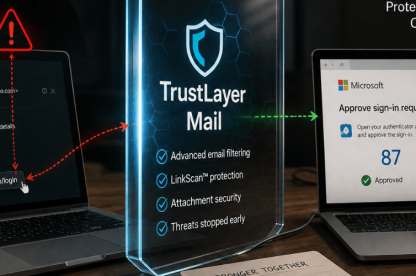
Sophisticated attackers monitor LinkedIn, track travel calendars, and send well‑timed messages. Security teams require more than inbox filters to stay ahead. That’s why TrustLayer includes LinkScan — verifying every URL at delivery and again at the moment of click, so the true destination is revealed before a user gets there. Protection needs to be context‑aware, learning behaviour and alerting early by correlating signals across communication channels and user activity. This is the only way to outpace adaptive email‑based risks.
What are the consequences of an email security breach?
Any security lead with a few years under their belt has a breach story. One CISO we’ve worked with flagged a case where a spoofed finance email re‑routed supplier payments for an entire quarter before discovery. Another saw ransomware enters via a shared file that looked like a barrister’s bundle. These aren’t fringe cases, but operational risks driven by email threats.
The consequences hit fast: fraud, compliance failures, breach disclosures, and operational panic. Regulators expect readiness, and clients remember lapses in security.
Why filters alone don’t cut it
Signature‑based tools often miss high‑risk threats. Fake DocuSign links often carry no malware, and typo‑squatted domains may pass SPF and DKIM checks. Without behavioural analysis and time of click defence, defenders react too late.
To stop these attacks, platforms must analyse context: who is sending, what’s being asked, where it links, and whether the tone and timing match normal patterns. Anything less is exposure. Behavioural intelligence is critical to detecting modern email threats.
How do you stop email threats without breaking workflows?
Disruption kills adoption. That’s why effective email protection needs to stay invisible to users until it matters.
TrustLayer Mail Protection, with DirectProtect Email, was built for frontline teams. It detects anomalies based on how users behave instead of solely focusing on what lands in their inbox. It integrates natively with Microsoft 365 and Google Workspace, surfaces threats before users click, and keeps alert fatigue low so security teams can focus on real issues.
Teams stay focused on their work while TrustLayer monitors for early signs of compromise quietly and in real time. This means users are protected from email threats without having to change how they work.
With DirectProtect Email, TrustLayer connects directly into Microsoft 365 using native connectors and transport rules — no MX record changes, no mail rerouting, no disruption. That means you get inline protection that’s fast to deploy and simple to manage, while keeping workflows seamless for users.
What should you look for in an email security platform?
Some email security tools overwhelm your team with false alerts. Others miss the most dangerous activity. From experience, tools that drown admins in noisy alerts or vague reports get abandoned quickly.
When choosing an email threat platform, security leads typically look for:
- Seamless integration: The tool should work with what you’re already running: Google Workspace, Microsoft 365, and your security stack.
- Low false positives: Alert noise kills productivity. Tools need adaptive logic that gets sharper over time.
- Cross‑platform visibility: Security doesn’t stop at the inbox. You need threat correlation from endpoints, cloud apps, and user behaviour.
- Real‑time phishing trends: Visibility into who’s getting targeted, how, and why.
- Board‑ready reporting: CISOs need to show what’s working. Make policy measurable.
Strong tools need to provide measurable protection against a wide range of email‑based risks while remaining simple enough to deploy and use.
Case Study: TrustLayer goes back to school
A growing UK educational trust needed stronger controls to manage phishing, shadow IT, and policy enforcement across dozens of school sites. TrustLayer delivered full visibility into staff behaviour, improved protection for sensitive student data, and simplified multi‑site management for IT leads.
Read the full case study here.
TrustLayer’s approach: built for real‑world risks
Email protection operates as part of a broader security strategy. TrustLayer ties email defences to posture management by detecting misconfigurations, monitoring user behaviour, and correlating endpoint data to reduce exploitable gaps.
With TrustLayer, you gain visibility into risky configurations and user actions across cloud tools and endpoints. It flags phishing risks before users act and adjusts policy enforcement dynamically without the noise. That means stronger protection, lower admin effort, and measurable outcomes security leaders can report on. These are tangible defences against a constantly evolving threat landscape tied to email communications.
Strengthen your email defence with TrustLayer
Email is where most threats begin. It should be the first place you gain control.
If you don’t have visibility into risky clicks or confidence in your policy impact, exploring TrustLayer Mail is a smart next step. It’s designed to neutralise email threats while preserving your team’s workflow and your peace of mind.
Want to see how? Book a free demo and discover how email protection fits into full-stack cloud defence.