TrustLayer as a Forcepoint alternative.
Three Forcepoint products your web security may depend on have either lost support already or lose it on 31 December 2026. Here are the dates, from Forcepoint's own lifecycle matrix, and what a replacement looks like.
Check which of these you're running.
URL Filtering 8.5.5 support ended on 31 December 2025.
And if your email is on 8.5.4 or 8.5.5, both deadlines land on the same day, which means one procurement decision rather than two.
Standalone Forcepoint CASB has been gone since 2023, with customers migrated into what was then Forcepoint ONE and is now Forcepoint Data Security Cloud.Sources: Forcepoint Product Support Life Cycle matrix. Screenshots on file.
A data security platform. Web is third in the list.
"Forcepoint is the global AI data security leader. The company's AI Data Security platform knows sensitive data as it is created, adapts the moment risk changes and protects continuously across cloud, web, networks, email, endpoints and AI."Company boilerplate, since July 2026
Web is third in that list and email is fifth. Forcepoint still sells both, and both had releases in 2026, so we're not going to tell you they're being discontinued. What we'd say is that web filtering and email security are now components of a data security platform rather than the point of the product, and roadmap attention tends to follow positioning.
The platform has also been renamed twice in two years: Forcepoint ONE became Forcepoint ONE Data Security in 2024, then Forcepoint Data Security Cloud in April 2025, and now sits under the AI Data Security platform. The secure service edge technology underneath came from Bitglass, acquired in October 2021.
And if you still call it Websense, you are not behind the times so much as ahead of the branding. Websense was renamed Forcepoint in 2016, after the Raytheon acquisition. A good share of the web filtering estates now reaching these end-of-support dates were bought under the old name, and the dates in the table above are the ones that apply to them.
Plus three ownership changes and the 2023 divestiture of the government business to TPG, now trading as Everfox.
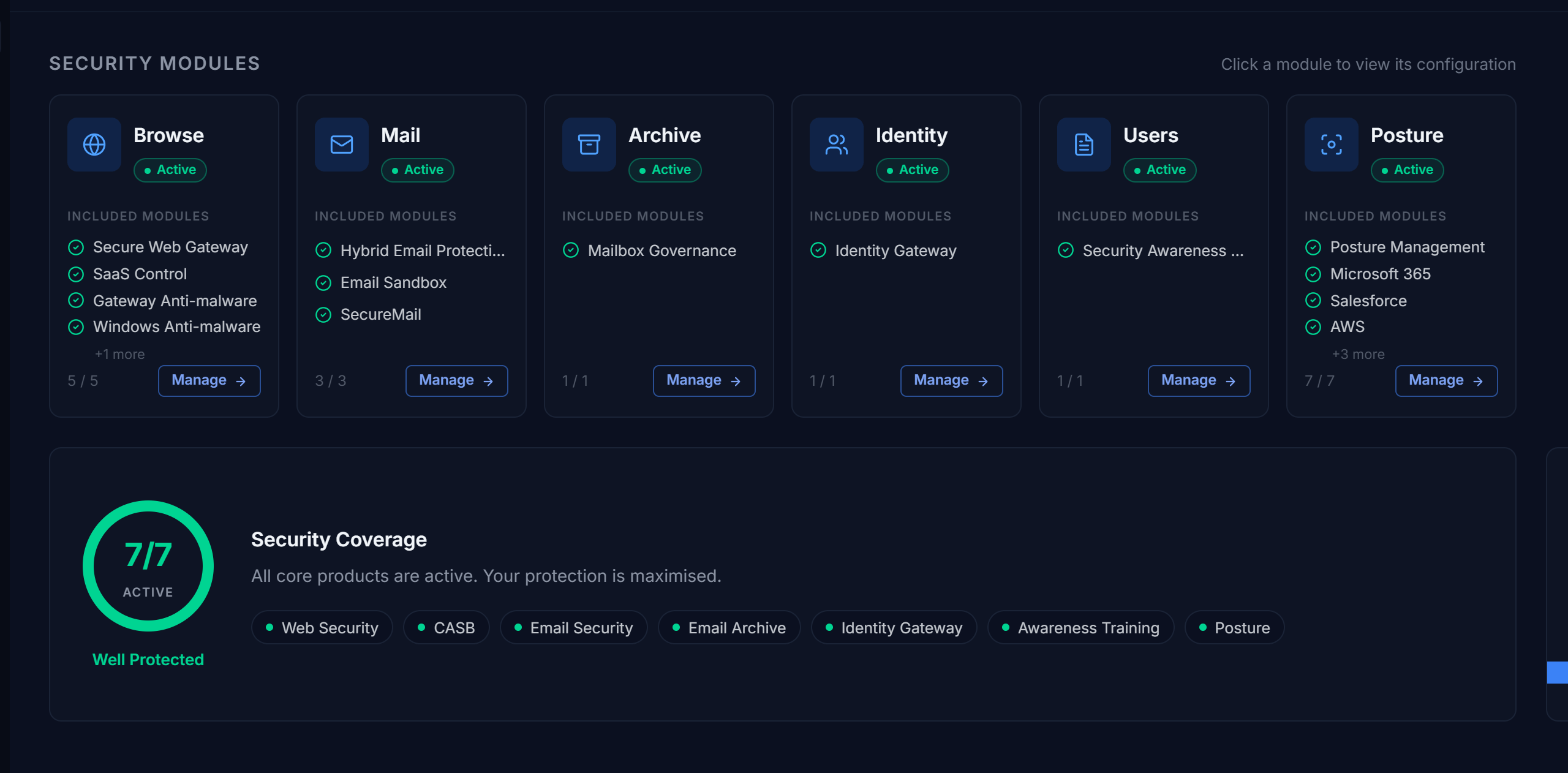
TrustLayer has one platform, built as one platform. Four layers, one policy model, one console, and nothing in it acquired from somewhere else and bolted on.
Browse. Enforced on the device.
TrustLayer Browse is web security, CASB and AI Exposure, enforced on the device.
No proxy and no tunnel, so there's nothing in the traffic path and no appliance to size. Policy is applied on the laptop before the request leaves it, which means the same rules in the office, at home and on hotel wifi. Pushed through Intune, Jamf or any MDM, on Windows and macOS.
Web first. Then email. Then the platform.
Both do advanced malware detection well, and both cover out-of-hours. Forcepoint wins on DLP, classification and network security, and still ships appliances if you want them. The web rows are where the calendar is doing the arguing.
Where Forcepoint is the better choice.