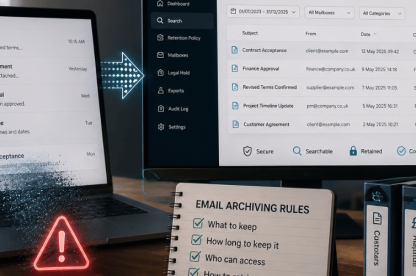
Is hybrid work exposing gaps that smarter email archiving can close?
Working patterns have altered how UK organisations communicate and retain records. Email now flows across home networks and mobile devices, creating challenges for governance teams tasked with retaining complete and accurate communications.
As working patterns fragment, oversight becomes harder to maintain. Messages that once passed through controlled office environments now travel through a wider range of endpoints and access conditions, increasing the chance that records become incomplete or difficult to retrieve.
Are hybrid working patterns changing how email records are created?
Changes in working patterns affect when and how staff communicate. Threads can start on one device and finish on another, with handovers across locations.
This creates email archiving weaknesses in hybrid settings where capture depends on assumptions tied to office-based use. Messages sent from unmanaged devices can fall outside retention policies.
Organisations assessing email archiving for hybrid work UK conditions need to understand how these patterns affect record completeness.
Where do email records slip through in hybrid teams?
Gaps appear at the edges of communication. Teams operating across locations use forwarding and shared inbox access to keep work moving.
In these situations, messages can bypass expected capture paths. Personal devices and mailbox delegation increase the chance that records are stored inconsistently, which makes later retrieval slower.
Email archiving weaknesses in hybrid workforce settings usually surface when organisations try to reconstruct conversations weeks or months later. Cross-team projects increase the risk, since email chains become the linking record between groups that do not share the same systems.
How does it support compliance across remote locations?
Regulatory expectations require organisations to retain business communications in a way that supports review. Dispersed working patterns spread those communications across locations that compliance teams do not physically control.
A central archive provides a record that remains consistent regardless of where staff work. Captured messages support audit readiness and reduce the risk of incomplete disclosure.
Best practices for UK firms emphasise retention policies aligned with regulatory duties. UK regulatory frameworks also expect consistent retention across devices and locations, which increases pressure on disciplined capture.
What risks arise when email data lacks structure?
Unstructured retention increases exposure during disputes or investigations. Teams may spend time searching personal mailboxes or exporting data manually.
Key risks include:
- Delayed responses to legal or regulatory requests
- Incomplete reconstruction of decision trails
- Dependence on individual users to supply records
Smarter email archiving solutions address these risks by maintaining consistent capture and search across distributed workforces. That search matters during investigations and audits because teams must locate complete conversations without waiting on individual custodians.
Why do manual retention methods struggle with hybrid work?
Manual retention relies on staff following guidance under varying conditions. Forwarding emails to shared folders or saving copies locally depends on judgement calls made under time pressure. Errors become visible only when records are requested.
By capturing messages as they are sent or received, email archiving removes that dependency and reduces the chance of omission. Shared and delegated inbox use also increases, with multiple users handling one mailbox across a day.
How should organisations review archiving policies for hybrid teams?
Policy review should focus on how communication actually occurs. Distributed working blurs boundaries between internal and external messaging.
Reviews should examine retention scope and access rights. Attention to these areas helps identify where policies fail to match working practice.
Email archiving for hybrid work UK strategies benefit from periodic reassessment as working patterns continue to change. Reviews should also cover access to archived records, since legal, compliance, and HR teams require different levels of access depending on their role.
How can smarter email archiving close hybrid work weaknesses?
Smarter email archiving solutions focus on capturing messages based on policy instead of user behaviour. Automated capture reduces dependence on staff remembering retention steps.
Central indexing allows compliance teams to locate conversations without involving individual employees. Faster retrieval supports response during audits and internal reviews.
Closing email archiving weaknesses in hybrid teams requires systems that operate consistently across devices and locations, preserving records without disrupting daily work. Organisations operating across locations also benefit from linking retention with access management, so responsibilities remain defined.
How does staff turnover affect access to historic email records?
Changes in working arrangements increase the risk that key correspondence becomes tied to one person’s inbox. Departing employees can leave behind approval trails or discussions with suppliers that explain later outcomes.
Access changes create practical problems during investigations. When accounts are disabled or reassigned, teams may lose the ability to view entire threads, attachments, or context that explains why decisions were taken. This becomes more challenging where work spans multiple teams and time periods.
Continuity matters during disputes and regulatory enquiries. Central retention prevents weaknesses caused by role changes and staff exits, allowing authorised teams to review communications without delay.
Through controlled access, email archiving supports continuity even after roles change or accounts are closed.
What should UK teams check before relying on an archive during an investigation?
An archive only helps if it captures the right material and returns it in a usable form. Before an incident, teams can validate coverage by checking whether:
- Shared mailboxes and delegated access are captured consistently
- Search returns complete threads, including attachments and metadata
- Access controls match internal roles for legal and compliance work
- Retention policies match internal duties and external expectations
How do legal requests expose weaknesses in email retention?
Legal and regulatory requests place immediate pressure on retention processes. Deadlines limit the time available to locate records, confirm completeness, and prepare responses.
Distributed working increases the likelihood that relevant communications are scattered across shared inboxes. Without structured retention, teams may need to contact individuals or restore accounts, which delays response and increases risk.
Centralised retention supports faster disclosure by keeping business communications accessible to authorised teams. Preparation before requests arrive reduces disruption and protects organisational credibility.
How does TrustLayer support compliant email records at scale?
Centralised capture and search make record retrieval easier without relying on individual mailboxes. Email archiving with us supports compliance requirements and investigative readiness across distributed teams.
Want to review how your communication records are retained? Book a demo to see how we support email archiving.